Should we stop treating mild (stage 1) hypertension?

I am preparing for a talk on the controversy surrounding JNC-8 and came across a post on KevinMD.com by an author of a Cochrane systematic review that aimed to quantify the effects of antihypertensive drug therapy on mortality and morbidity in adults with mild hypertension (systolic blood pressure (BP) 140-159 mmHg and/or diastolic BP 90-99 mmHg) and without cardiovascular disease. This is an important endeavor because the majority of people we consider treating for mild hypertension have no underlying cardiovascular disease.

David Cundiff, MD in his KevinMD.com post made this statement:

The JNC-8 authors simply ignored a systematic review that I co-authored in the Cochrane Database of Systematic Reviews that found no evidence supporting drug treatment for patients of any age with mild hypertension (SBP: 140-159 and/or DBP 90-99) and no previous cardiovascular disease, diabetes, or renal disease (i.e., low risk).

Let’s see if you agree with his assessment of the findings of his systematic review.

As is typical for a Cochrane review the methods are impeccable so we don’t need to critically appraise the review and can review the results. The following images are figures from the review. Examine them and then I will discuss my take on the results.

mortality

Mortality results


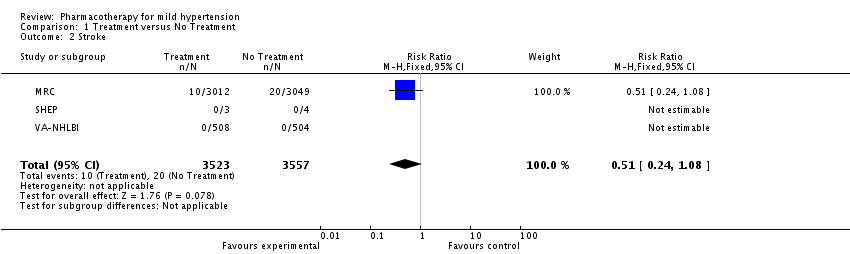
stroke

Stroke results


CHD

Coronary Heart Disease results


adverse effects

Adverse Effects


If you just look at the summary point estimates (black diamonds) you would conclude the treatment of mild hypertension in adults without cardiovascular disease has no effect on mortality, stroke and coronary heart disease but greatly increases withdrawal from the study due to adverse effects. But you are a smarter audience than this. The real crux is in the studies listed and examination of the confidence intervals.

Lets examine stroke closely. 3 studies were included that examined the treatment of mild hypertension on stroke outcomes. Two of the studies had no stroke outcomes at all. The majority of the data came from one study. The point estimate of effect was in fact a reduction of stroke by 49% but the confidence interval included 1.0 so not statistically significant. But the confidence interval ranged from 0.24-1.08- a potential 76% reduction in stroke up to an 8% increase. I would argue that a clinically important effect (stroke reduction) is very possible and had the studies been higher powered we would have seen a statistically significant reduction also. I think to suggest no effect on stroke is misleading. The same can be said for mortality.

Finally, what about withdrawals due to adverse effects. Only 1 study provided any data. It has an impressive risk ratio of 4.80 (almost 5 fold increased risk of stopping the drugs due to adverse effects). But the absolute risk increase is only 9% (NNH 11). We are not told what these adverse effects are to know if they were clinically worrisome or just nuisances for patients.

So, I don’t agree with Dr. Cundiff’s assessment that there is no evidence supporting treatment. I think the evidence is weak but there is no strong evidence to say we shouldn’t treat mild hypertension. The confidence intervals include clinically important benefits to patients. More studies are needed but will not be forthcoming. Observational data supports treating this group of patients and may have to be relied upon in making clinical recommendations.


Useful diagram to teach basic EBM concepts

Dr. La Rochelle published an article in BMJ EBM this month with a very useful figure in it (see below). It is useful because it can help our learners (and ourselves) remember the relationship between the type of evidence and its believability/trustworthiness.

Untitled

Lets work through this figure. The upright triangle should be familiar to EBM aficionados as it is the typical hierarchy triangle of study designs, with lower quality evidence at the bottom and highest quality at the top (assuming, of course, that the studies were conducted properly). The “Risk of Bias” arrow next to this upright triangle reflects the quality statement I just made.  Case reports and case series, because they have no comparator group and aren’t systematically selected are at very high risk of bias. A large RCT or systematic review of RCTs is at the lowest risk of bias.

The inverted triangle on the left reflects possible study effects, with the width of the corresponding area of the triangle (as well as the “Frequency of Potential Clinically relevant observable effect arrow) representing the prevalence of that effect. Thus, very dramatic, treatment altering effects are rare (bottom of triangle, very narrow). Conversely, small effects are fairly common (top of triangle, widest part).

One way to use this diagram in teaching is to consider the study design you would choose (or look for) based on the anticipated magnitude of effect. Thus, if you are trying to detect a small effect you will need a large study that is methodologically sound. Remember bias is a systematic error in a study that makes the findings of the study depart from the truth. Small effects seen in studies lower down the upright pyramid are potentially biased (ie not true). If you anticipate very large effects then observational studies or small RCTs might be just fine.

An alternative way to use this diagram with learners is to temper the findings of a study. If a small effect is seen in a small, lower quality study they should be taught to question that finding as likely departing from the truth. Don’t change clinical practice based on it, but await another study. A very large effect, even in a lower quality study, is likely true but maybe not as dramatic as it seems (ie reduce the effect by 20-30%).

I applaud Dr. La Rochelle for developing a figure which explains these relationships so well.

EBM Rater is finally available

I have always suspected that one reason that physicians don’t critically appraise articles is that the criteria for critical appraisal are not readily available in a convenient, easy to use package. No more. I, with the help of some undergraduate computer science students, have created a critical appraisal app for Android devices. Its in the Google playstore and will be listed in the Amazon app store. Hopefully will develop an iOS version if this version is successful.


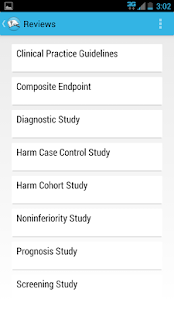
screen shot

I tried to take critical appraisal to the next step by “scoring” each study and giving an estimate of the bias in the study. I then make a recommendation of whether or not the user should trust the study or reject it and look for another study. I think one of the shortcomings of the Users’ Guides series is that no direction is given to the user about what to do with the article after you critically appraise it. EBM Rater will give a suggestion about the trustworthiness of the study.

EBM Rater contains criteria to critically appraise all the major study designs including noninferiority studies. It even contains criteria to evaluate surrogate endpoints, composite endpoints, and subgroup effects.
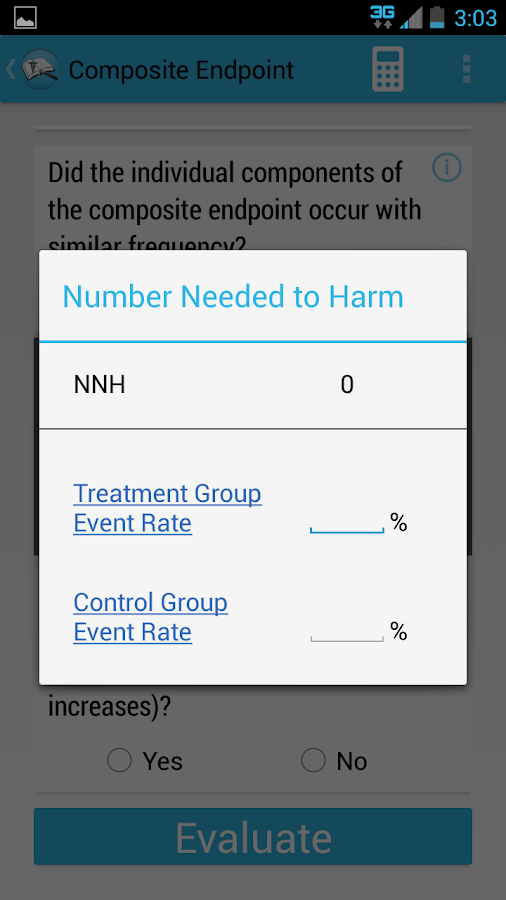
screen shot

Finally, it contains standard EBM calculators like NNT, NNH, and posttest probability. I added 2 unique calculators that I have not seen in any other app: patients specific NNT and NNH. Many of our patients are sicker or healthier that the patients included in a study.  NNTs and NNHs are typically calculated with data from a study so the NNT and NNH is for the study patients. With my calculator you can figure out your individual patient’s NNT or NNH.

screen shot

I hope you will give it a try and give me some feedback.

Allocation Concealment Is Often Confused With Blinding

During journal clubs on randomized controlled trials there is often confusion about allocation concealment. It is often confused with blinding. In a sense it is blinding but not in the traditional sense of blinding. One way to think of allocation concealment is blinding of the randomization schedule or scheme. Allocation concealment hides the randomization or allocation sequence (what’s coming next) from patients and those who would enroll patients in a study. Blinding occurs after randomization and keeps patients, providers, researchers, etc from knowing which arm of the study the patient is in (i.e. what treatment they are getting).

Why is allocation concealment important in a randomized controlled trial? Inadequate or unclear allocation concealment can lead to an overestimation (by up to 40%!) of treatment effect (JAMA 1995;273:408). First, consider why we randomize in the first place. We randomize to try to equally distribute confounding and prognostic factors between arms of a study so we can try to isolate the effect of the intervention. Consider a physician who wants to enroll a patient in a study and wants to make sure her patient receives the therapy she deems likely most effective. What if she figured out the randomization scheme and knows what therapy the next patient will be assigned to? Hopefully you can see that this physician could undermine the benefits of randomization if she preferentially funnels sicker (or healthier) patients into one arm of the study. There could be an imbalance in baseline characteristics. It could also lead to patients who are enrolled in the study being fundamentally different or not representative of the patient population.

From The Lancet

From The Lancet

You will have to use your judgment to decide how likely it is that someone could figure out the randomization scheme. You can feel more comfortable that allocation concealment was adequate if the following were used in the RCT:
sequentially numbered, opaque, sealed envelopes: these are not able to be seen through even if held up to a light. They are sealed so that you can’t peek into them and see what the assignment is. As each patient is enrolled you use the next numbered envelope.
pharmacy controlled: enrolling physician calls the pharmacy and they enroll the patient and assign therapy.
centralized randomization: probably the most commonly used. The enrolling physician calls a central research site and the central site assigns the patient to therapy.

Proper randomization is crucial to a therapy study and concealed allocation is crucial to randomization. I hope this post helps readers of RCTs better understand what concealed allocation is and learn how to detect whether it was done adequately or not. Keep in mind if allocation concealment is unclear or done poorly the effect you see in the study needs to be tempered and possible cut by 40%.

Do You Have An Unconfortable Relationship With Math? A Study Shows Most Doctors Do

If a test to detect a disease whose prevalence is 1/1000 has a false positive rate of 5%, what is the chance that a person with a positive test result actually has the disease? Assume the test is 100% sensitive.

Everyone taking care of patients, especially in primary care, needs to be able to figure this out. This is a basic understanding of what to do with a positive screening test result. If you can’t figure this out how would you be able to discuss the results with a patient? Or better yet how would you be able to counsel a patient on the implications of a positive test result prior to ordering a screening test?

Unfortunately, a study released online on April 21st found that 77% of respondents answered the question incorrectly. These results are similar to the results of a study in 1978, which used the same scenario. This is unfortunate as interpreting diagnostic test results is a cornerstone of EBM teaching and almost all (if not all) medical schools and residency programs teach EBM principles. So what’s the problem?

Here are some of my thoughts and observations:

  1. These principles are probably not actually being taught because the teachers themselves don’t understand them or if they do they don’t teach them in the proper context. This needs to be taught in the clinic when residents and medical students discuss ordering screening tests or on the wards when considering a stress test or cardiac catheterization, etc.
  2. The most common answer in the study was 95% (wrong answer). This shows that doctors don’t understand the influence of pretest probability (or prevalence) on post test probability (or predictive value). They assume a positive test equals disease. They assume a negative test equals no disease.  Remember where you end up (posttest probability) depends on where you start from (pretest probability).
  3. I commonly see a simple lack of thinking when ordering tests. How many of you stop to think: What is the pretest probability? Based on that do I want to rule in or rule out disease? Based on that do I need a sensitive or specific test? What are the test properties of the test I plan to order? (or do I just order the same test all the time for the same diagnosis?)
  4. I also see tests ordered for presumably defensive purposes. Does everyone need a CT in the ER? Does everyone need a d-dimer for every little twinge of chest pain? When you ask why a test was ordered I usually hear something like this: “Well I needed to make sure something bad wasn’t going on”.  I think this mindset transfers to the housestaff and students who perpetuate it.  I commonly see the results of the ER CT in the HPI for God’s sake!!!
  5. Laziness. There’s an app for that. Even if you can’t remember the formula or how to set up a 2×2 table your smartphone and Google are your friends.  Information management is an important skill.

So what’s the answer to the question above? 1.96%   (Remember PPV = true pos / true pos + false pos  so 1 / 1 + 50 = 1.96) If its easier set up a 2 x 2 table.

This very sensitive (100%) and fairly specific (95%) test (positive LR is 20!) wasn’t very informative when positive. Probability only went from 0.1% to 2%. The patient is still not likely to have disease even with a positive test.  It would have been more useful if the test result was negative. Thus, in a low probability setting your goal is to rule out disease and you should choose the most sensitive test (Remember SnNout).


PEITHO Trial Teaches an Important Lesson

The current issue of the New England Journal of Medicine contains an important trial- the PEITHO trial. Its important because it tells us what not to do.

In the PEITHO trial patients with intermediate risk pulmonary embolism (right ventricular dysfunction and myocardial injury with no hemodynamic compromise) were randomized to a single weight-based bolus of tenecteplase or placebo. All patients were given unfractionated heparin. Patients were followed for 30 days for the primary outcome of death from any cause or hemodynamic decompensation within 7 days after randomization.

This table shows the efficacy outcomes. Looks promising doesn’t it.

PEITHO efficacy outcomes

The primary outcome was significantly reduced by 56%. This composite outcome is not a good one though. Patients would not consider death and hemodynamic decompensation equal. Also the pathophysiology of the 2 outcomes can be quite different. The intervention should also have a similar effect on all components of a good composite and there is a greater effect on hemodynamic decompensation than death. Thus, don’t pay attention to the composite but look at the composite’s individual components. Only hemodynamic decompensation was significantly reduced (ARR 3.4%, NNT 30). Don’t get me wrong this is a good thing to reduce.

But with all good can come some bad. This trial teaches that we must pay attention to adverse effects. The table below shows the safety outcomes of the PEITHO trial. Is the benefit worth the risk?

PEITHO safety outcomes

You can see from the table that major extracranial bleeding was increased 5 fold (ARI 5.1%, NNH 20) as was stroke, with most of them being hemorrhagic (ARI 1.8%, NNH 55).

This trial teaches a few important EBM points (I will ignore the clinical points it makes):

  1. You must always weigh the risks and benefits of every intervention.
  2. Ignore relative measures of outcomes (in this case the odds ratios) and calculate the absolute effects followed by NNT and NNH. These are much easier to compare.
  3. Watch out for bad composite endpoints. Always look at individual components of a composite endpoint to see what was affected.

I’m Still Not Crazy About the Pooled Risk Equations in the New Cholesterol Guidelines

2 papers got published this week to further validate the pooled risk equations developed for the ACC/AHA Cholesterol Guidelines.
Muntner and colleagues used the REGARDS participants to assess the calibration and discrimination of the pooled risk equations. This study had potential as it oversampled patients from the stroke belt. This is important because the Pooled Risk Equations were developed  to overcome the limitations of the Framingham tool (mainly its lack of minorities).  I have a real problem with this study because the pooled risk equations estimate 10 yr risk of CHD and stroke and this study only has 5 yrs of follow-up for the REGARDS participants. I don’t think their estimates of calibration and discrimination are valid. Risk of CHD and stroke should increase over time so event rates could change with 5 more years of follow-up. The important thing this paper adds is the reminder that observational studies often lack active surveillance. Most observational studies rely on self report of outcomes and obviously silent events would be missed by the patient as would events for which the patient didn’t seek evaluation. Muntner and colleagues also used Medicare claims data to identify events not detected through routine cohort follow-up and found 24% more events. This is a useful lesson from this study.

In a more useful study Kavousi and colleagues compared 3 risk prediction tools (pooled risk equations, Framingham, and SCORE)  using the Rotterdam Study, a prospective population-based cohort of persons aged 55 yrs and older. This cohort does have 10 yrs of follow-up.

overprediction

This figure shows that at each level of risk the pooled risk equations overestimated risk, though less so in women.

treatment rec

This figure shows the proportion of patients for whom treatment is recommended (red bars), treatment should be considered (yellow bars), and no treatment is recommended (green bars). As you can see the new risk tool leads to the large majority of men “needing treatment” compared to previous guidelines (ATP III) and the current European guidelines (ESC).

calibration curves

Finally, this figure shows the calibration curves and the calibration was not good. The blue dots should lie right upon the red line for good calibration. Furthermore, the c-statistic is 0.67 (a measure of discrimination which means the tool can differentiate diseased from nondiseased patients. A c-statitic above 0.7 is considered moderate to good. The closer to 1 the better).

Why might the pooled risk equations overestimate risk? Maybe they don’t if you believe the Muntner study. It could just be a problem with the lack of active surveillance in the cohort studies used to validate the tool. Or they really do overestimate risk because they aren’t accurate or maybe more contemporary patients receive better therapies that improve overall health or maybe the baseline risk characteristics of the validation cohorts just differ too much from the development cohorts.

I am still not sold on the new pooled risk equations but they might not be much better than what we have been using based on the Kavousi study (Framinham also overpredicted risk and had poor calibration). I think we need more study and tweaking of the tool or we use the tool as is and focus more on cardiovascular risk reduction (with exercise, diet, tobacco cessation, diabetes and HTN control) and don’t focus so much on starting a statin right away.

The Mayo Clinic has a nice patient decision aid that you can use to help patients decide if a statin is right for them: http://statindecisionaid.mayoclinic.org/index.php/site/index


Answering Clinical Questions at the Point of Care- Its Time to Stop Making Excuses!

Del Fiol and colleagues published a systematic review of studies examining the questions raised and answered by clinicians in the context of patient care.  The studies they examined used several methodologies including after-visit interviews, clinician self-report, direct observation, analysis of questions submitted to an information service, and analysis of information resource search logs. Each of these methodologies has their pros and cons. I’ll review their findings following the 4 questions that they asked.

How often do clinicians raise clinical questions? On average, clinicians ask 1 question for every 2 patients (range 0.16-1.85).

How often do clinicians pursue questions they raise? On average, they only pursued 47% (range 22-71%).

How often do clinicians succeed at answering the questions they pursue? They were pretty successful when they decided to pursue an answer: 80% of the time they were able to answer the question. Interestingly, clinicians spent less than 2-3 minutes seeking an answer to a specific question.  They were clearly choosing questions that could be answered fairly quickly when they decided to pursue the answer to a  question.

What types of questions were asked? Overall, 34% of questions were related to drug treatment while 24% were related to the potential causes of a symptoms, physical finding, or diagnostic test finding.

I find 3 other findings (from the Box in the manuscript) interesting:

  • Most questions were pursued with the patient still in the practice (not sure if the clinicians searched in front of the patient or left the room- more about this later)
  • Most questions, as you would expect, are highly patient-specific and nongeneralizable.  This is unfortunate for long-term learning.
  • Also unfortunately, clinicians mainly used paper and human resources (more on this in a minute)

From ticklemeentertainment.com

Even though Del Fiol examined barriers to answering questions I refer to another study by Cook and colleagues that more closely examined barriers to answering clinical questions at the point of care. Cook did focus groups with a sample of 50 primary care and subspecialist internal medicine and family medicine physicians to understand barriers and factors that influence point of care learning/question answering. Of course the main barrier is time. This study was done in late 2011 into early 2012 and included a wide range of ages of participants. With the resources available on both the desktop and handheld devices this barrier should be declining, especially when you consider the most common question clinicians ask is about drug treatment.

Physicians frequently noted patient complexity as a barrier. Complex patients require more time and often lead to more complex questions that are harder to answer with many resources. Almost all guidelines and studies are focused on single disease patients. Multimorbidity is rarely covered. Thus many answers will likely rely on clinical expertise and judgment. This is where using human resources is likely to occur. I bet few of us question how up to date our colleagues are that we ask questions of.

Interestingly, Cook’s study participants identified the sheer volume of information as a barrier. As a result, these physicians used textbooks more than electronic resources. I wonder if they understand that a print textbook is at least a year out of date by the time it hits market. How often do they update their textbooks? (likely rarely…just look at a private practice doctor’s bookshelf and you will often see books that are at least 2 or more editions out of date).

Finally, the physicians in Cook’s study felt that searching for information in front of the patient might “damage the patient-physician relationship or make patients uncomfortable.” They couldn’t be more wrong. Patients actually like when we look things up in front of them.  I always do this and I tell them what I am looking up and admit my knowledge limitation. I show them what I found so they can participate in decision making. No one can know everything and patients understand that. I would be wary of a physician who doesn’t look something up.

So, how should a busy clinician go about answering clinical questions?

  1. You must have access to trustworthy resources.  2 main resources should suffice: a drug resource (like Epocrates or Micromedex- both are free and available for smartphones and desk tops) and what Haynes  labels as a “Summary” (Dynamed or UpToDate).  I leave guidelines out here (even though they are classified as a “Summary” resource) because most guidelines are too narrowly focused and many are not explicit enough in their biases.
  2. Answer the most important questions (most important to the patient #1 and then most important to improving your knowledge #2). If the above resources can’t answer your question and you must consult a colleague challenge them to support their opinion with data. You will learn something and likely they will too.
  3. Answer the questions you can in the available time. Many questions should be able to be answered in 5 min or less using the above resources. You are more likely to search for an answer to a question while the patient is in your office than waiting until the end of the day (the above cited studies can attest to that).
  4. Be creative in answering questions. I saw a great video by Paul Glasziou (sorry can’t remember which of his videos it was to link) where he discussed a practice-based journal club. Your partners likely are developing similar questions as your are. This is how he recommends organizing each journal club session: step 1 (10 min) discuss new questions or topics to research, step 2 (40 min) read and appraise (if needed) a research paper for last week’s problem, and step 3 (10 min) develop an action plan to implement what you just learned. This is doable and makes your practice evidence-based and feel somewhat academic. If you follow the Haynes hierarchy and pick the right types of journal articles (synopses and summaries) you can skip the appraisal part and just use the evidence directly.

Ultimately you have to develop a culture of answering questions in your practice. It has to be something you truly value or you won’t do it.  Resources are available to answer questions at the point of care in a timely fashion. At some point we have to stop making excuses for not answering clinical questions.

Should Natriuretic Peptide Guide Chronic CHF Therapy?

Guideline recommended heart failure care is generally followed by most primary care doctors. They prescribe ACE inhibitors, beta-blockers, and occasionally mineralocorticoid receptor antagonists. Despite prescribing these proven medications many patients remain symptomatic, are frequently admitted to the hospital and maybe even die prematurely. One of the main problems is that doctors often don’t titrate medications to the doses used in the landmark studies of these agents. There are several reasons for this but one is just plain lack of knowledge of what the target doses are. I know I am guilty of not teaching my house staff what the target doses are. We often start a medication in the hospital or titrate it slightly but leave the final dose adjustments to the outpatient physicians (we of course assume they will do what’s right). A missed teaching opportunity on my part which I will be correcting this month on my inpatient service. I am going to use a nifty app on my iPad called MyStudies (no affiliation). The app is free but the full complement of journal articles costs $10/year. I plan to use it to review landmark trials with my house staff and I am focusing on making sure they know the target doses of drugs. Most of us adjust med doses based on symptoms or physical findings. Could using a lab test (that seems to always get checked by my ER no matter what the complaint) help us primary care physicians do a better job taking care of CHF patients? This month in the European Heart Journal Troughton and colleagues published an individual patient data meta-analysis on using B-type natriuretic peptide to guide therapy in patients with chronic, largely systolic CHF.  Previous meta-analyses on this topic used study level data and had limitations in what they could adjust for- something that a patient-level meta-analysis is much better suited for. The methodology was fair but not Cochrane level (somewhat limited search strategy, not very explicit about how they did things, no information on publication bias, etc). They wanted to compare BNP guided therapy with clinically guided therapy and they found 9 studies with 2151 total patients that met their inclusion criteria (RCTs reporting all cause mortality). Despite the lack of statistical heterogeneity there is definitely clinical heterogeneity in their included studies ( different target levels of BNP, different study periods, different durations of follow up, different treatment algorithms).  Most studies were fairly small with 69-499  patients enrolled.

BP017%20ANP%20new

What did they find? BNP guided therapy reduced all-cause mortality by 3.4% (19.3% mortality in clinically guided therapy vs 15.9% in BNP guided therapy). This difference was only seen in those under 75 yrs of age as can be seen in this figure. Heart failure hospitalizations were also reduced by 4.7% (27.5% in clinically guided therapy vs 22.8% in BNP guided therapy). Interestingly, there were similar levels of decline in proBNP levels in both groups. I had anticipated BNP guided therapy would result in greater reductions in proBNP levels.

What explains their findings? There are several possible explanations:

  1. The most obvious is that patients in the BNP guided arm received more dose titrations of medications. They found that only ACE or ARBs doses increased in the included studies and only by 8.4%.  No dose increases were seen with beta-blockers or mineralocorticoid receptor antagonists. Loop diuretic doses also stayed the same. The authors found that increasing doses of each of these medications was significantly associated with reduced all-cause mortality.
  2. I wonder if cointerventions (like diet counseling, medication compliance counseling) were intensified in the BNP guided arms more so than in the clinically guided arms. This would not likely be captured in these studies and could explain lower event rates despite minimal increases in ACE inhibitor doses.
  3. Could other agents not measured (like digoxin) been added in the BNP guided arms. Digoxin does lower hospitalization rates. No information is given in the meta-analysis about this and I didn’t go back to the individual studies to see how they handled cointerventions.
  4. Referral to specialty care- this is possible I guess but one of the main effects would be greater titration of meds by cardiologists. ICDs or pacing could have also been done but again this would be related to cointerventions and I would hope this would not have been done differentially.
  5. BNP guided patients could have been seen more frequently by their providers- possible but this should mostly lead to dose titrations or lifestyle modification counseling.
  6. Hawthorne effect

I am not planning to order and follow BNPs on all my CHF patients. Why? Isn’t that what the evidence would say to do?  I think the key is not necessarily the lab test but making sure you titrate doses to those used in the studies. Dose increasing is all that these studies seem to suggest improves mortality.  I think BNP is just a reminder to do that. We need a study of BNP guided therapy vs a clinical pathway that titrates patients to goal doses independent of monitoring BNP. I suspect that study would show no differences in outcomes. You should also remember that BNP is not specific and is affected by renal function. None of the included studies enrolled patients with AKI or CKD (a problem I deal with often).

Intellectual Conflicts of Interest Are Harder to Deal With Than Financial

A colleague of mine wrote a blog post on conflicts of interest that I want to expand upon and discuss my recent experience with.

I am a member of a guideline panel (sponsoring organization not to be named) on screening for prostate cancer. I am the only primary care/internist on the panel (as best I can tell). The majority are urologists. Recently a revised guideline manuscript was sent around for comment. From my biased point of view (my intellectual conflict of interest) I was against several of the recommendations not only because the evidence didn’t strongly support it but also because I have to deal with the unhappy patients who undergo prostate cancer screening and are found to have something and ultimately get a procedure that worsens their quality of life. The urologists just couldn’t understand how I could be against screening all men and getting a baseline PSA at age 40. At one point I was referred to as “pathetic” that I would have such thoughts and teach my residents to follow the UPSTF recommendation against screening for prostate cancer in average risk men. Even the American Urological Association takes the stance to participate in shared decision making with men about prostate cancer screening.

From https://i0.wp.com/mesotheliomacancer1.info/wp-content/uploads/2013/12/prostate-cancer-screening.jpg

So why all the push back from my urological colleagues? The easy answer is financial. They make money from prostate biopsies and the surgical and hormonal treatment of prostate cancer. But I think it goes deeper than that especially since many are academic urologists and probably don’t have as great a financial incentive to evaluate and treat more prostate cancer (though I could be wrong). I think their intellectual conflict of interest is the main problem. Their research and academic beliefs are so strong that prostate cancer screening is good that they can’t see anyone else’s point of view (or view those views are equally meritorious). They can’t understand how I give greater value to the risk side of the risk/benefit equation. At least financial conflicts of interest are visible (when disclosed) and understandable. Intellectual conflicts of interest are usually subconscious and hard to overcome as I have found out. It will be an interesting face-to-face meeting this fall when we get together for another update.